Velvet Drive whine, rattle or clunk: what's normal and what isn't
 By Chris, Hale Marine · 40+ years rebuilding Velvet Drive and ZF transmissions
Whine in reverse: normal
Chris's rule of thumb is that the reverse planetary gears spin about 1,000 rpm for every 100 rpm coming in, so you hear them in reverse on any 71 or 72 series unit. On the test stand it only turns around 535 rpm; run the same transmission at 800 to 900 rpm in reverse out on the water and it's going to make a lot more noise. That's normal, not a sign of anything wrong.
Rattle or clunk at idle: usually the damper, not the transmission
A knock at idle or low rpm that clears up by around 1,000 rpm points to the damper plate, or an engine that's running rough, not the transmission. Chris tells owners the same thing: if it's at low rpm, raise the engine to about 1,000 rpm, and if the noise disappears, it's the engine or the damper. He's also told an owner flatly that it wasn't the transmission, it was the engine running rough causing the clatter. See damper plate noise in gear for how to tell a worn damper from a failed one.
A buzz or growl: low oil, air, or a sticking valve
The factory chart ties a hydraulic buzz to low oil, air in the system, or a sticking regulator valve. Running the transmission in neutral at around 1,200 rpm can purge trapped air. Gear noise, by the same chart, means broken or pitted gear teeth. Noise in both forward and reverse can mean the damper is misaligned with the engine, the output coupling is misaligned, or gear teeth are actually damaged.
When it's just how that model is
Some noise is just how a particular unit is built. The way Chris tells it, somebody complained the 1.91:1 made noise, so Velvet Drive went to the 1.88:1 gearing to quiet it down. When that didn't do it, they tried a rubber washer under the planetary, and that caused its own problem: the bolts would walk out or shear.
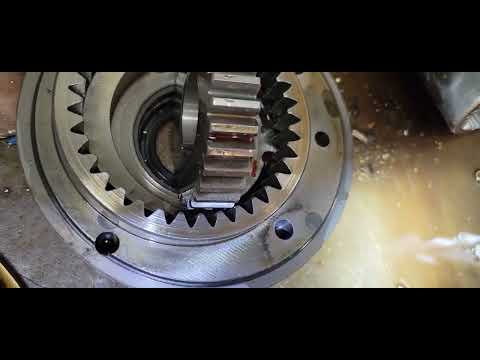
A noise that's new, or getting worse, is a different story. On one 1005 V-drive that had gotten loud enough that Chris had to ask how the owner hadn't heard it, the cause turned out to be a coupling nut that had backed off and let metal bang around inside. See output nut backing off. On 5000-series units specifically, a growling or bearing-type noise together with low pressure is a strong sign the pump is on its way out; an early 5000 with a worn gear-type pump read around 250 psi in gear on our stand, where a new pump gets closer to 350. See low transmission pressure.

Paragon: some reverse noise is normal too
On a Paragon transmission, some noise in reverse is normal, and pressure will dip on the shift into reverse before settling back to about 100-120 psi on our stand. If reverse is weak rather than just noisy, check the reverse band adjustment and the linkage arms on the reverse piston before assuming something's broken inside. See Paragon transmissions.
When to call
If a noise is new, getting louder, or shows up with low pressure, call (804) 333-3677, Monday through Friday 9 to 3 Eastern, or email sales@halemarine.com.
Related reading: damper plate noise in gear and low transmission pressure.
Common questions
Is a whine in reverse normal on a Velvet Drive?
Yes. The reverse planetary spins much faster than the input, and that whine gets louder the higher the rpm, whether that's on our test stand or out on the water.
Why does my transmission rattle or clunk at idle?
That pattern points to the damper plate or a rough-running engine, not the gearbox. The noise should clear up by about 1,000 rpm.
What causes a buzzing noise from the gearbox?
Velvet Drive's chart ties a hydraulic buzz to low oil or air in the system, or a sticking regulator valve.
When is a gearbox noise something to worry about?
When it's new, getting louder, or paired with low pressure or a bearing sound. That's wear, and it's time to have it looked at.
Sources
Public documents we used for this page. Links open other websites in a new tab.
- Borg-Warner Velvet Drive Service Manual, 71C/72C (Form 1289, 1988) (opens in a new tab) PDF, correctcraftfan.com