Velvet Drive vs ZF/Hurth: the differences that matter
Rotation names
A lot of the confusion between these two brands is vocabulary, not mechanics. ZF's own technical data sheets rate a transmission for "right hand turning" engines, defined as counterclockwise at the flywheel viewed from the flywheel end. Velvet Drive's paperwork calls that exact same rotation a "left hand" engine. It's the identical physical rotation described from opposite conventions. If you're cross-shopping a ZF spec sheet against a Velvet Drive manual, translate the naming before you compare anything else, or you'll end up thinking you need the opposite of what you actually need.
Duty ratings
ZF publishes duty-hour classes for the ZF63: pleasure use up to 500 hours a year (300 for mechanical control), light duty up to 2,000 hours, medium duty up to 3,500 hours, and continuous duty unlimited, for hydraulic transmissions smaller than ZF's 2000 series. Ratings are published for right-hand-turning engines; ZF asks installers to contact them for the opposite rotation. Velvet Drive's own duty classes work on a similar idea but different structure: Pleasure covers full throttle about 5 percent of the time, cruising at or under 80 percent of rated rpm, and under 400 hours a year; Light Duty Commercial and Heavy Duty Commercial classes step up from there. Both approaches are trying to answer the same question, how hard and how long the gearbox actually runs, they just slice it differently.
Freewheeling
Velvet Drive's own manuals state plainly that its transmissions can be freewheeled without risking damage while sailing or trolling on one engine, as long as the oil level is correct. That's a Velvet Drive statement about Velvet Drive transmissions. We don't have a documented ZF or Hurth freewheeling policy on file, so if you've got one of those behind a sailboat auxiliary, check that manufacturer's own literature rather than assuming the same allowance carries over. See our page on freewheeling under sail for the full detail on the Velvet Drive side.
Filters and drains
On a cast-iron 71 or 72 series Velvet Drive, older units sometimes have a spring and small washer behind the return plug, an earlier design Hale doesn't consider useful; a magnet further back in the housing is what actually catches stray metal, and a filter has never been what stops a failure. We don't have a comparable factory document for ZF/Hurth's internal filtering on file, so if you're servicing one of those, go by its own service literature rather than assume the Velvet Drive parts and practices carry over directly.
Pumps and pressure
Here's a place the two brands genuinely behave differently, and it trips people up if they don't know it ahead of time. On a Velvet Drive 5000 or Liberty, neutral pressure is low by design, about 10 to 50 psi at idle, because in neutral the pump flow bypasses the clutch pressure valve. That's normal, not a fault. On a ZF63, by contrast, a low neutral reading is a red flag. On our stand we look for something in the region of 300 to 350 psi across neutral, forward and reverse on a ZF63A, and we've read exactly 350/350/350 on units heading out the door. If someone hands you a low neutral number and tells you it's fine because "that's how a 5000 reads," make sure you know which brand of transmission is actually on the bench before you believe them.
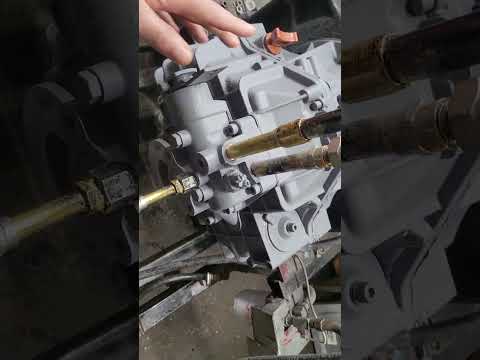
One ZF-specific wear point worth knowing: the O-ring at the coupling spline area hardens and stiffens with age, and once it does, fluid passes right by it, a second leak path besides the main seal. In Chris's words: "This is one of the few things I don't like about German engineering, they always think it, they have a O-ring that goes in here that gets hard... it's stiff with time and then the fluid just passes right by it."
What we like working on
We sell and service both, and we're an official Velvet Drive distributor. In Chris's experience, the 5000's pump is its weak link: the inner gear can crack from wear or a hard shift, and when it does, the resulting metal often takes the input shaft with it. That's part of why a 5000 rebuild gets a new pump as a matter of course. When a ZF63A went out the door to replace a 5000 that had scattered, Chris said on camera: "this is a much better transmission than the 5000, sad but true." That's a specific, honest comparison in a specific situation, not a blanket verdict on either brand. Both have their own weak points, and which one we'd rather see on the bench depends on what actually broke.


Related reading
Common questions
Is a ZF right-hand turning engine the same as a Velvet Drive left-hand engine?
Yes. Both describe an engine that turns counterclockwise at the flywheel; the manufacturers just use opposite naming conventions.
Does Velvet Drive's freewheeling-while-sailing approval apply to ZF or Hurth gearboxes?
We don't have a documented ZF or Hurth freewheeling statement on file. That approval is specific to Velvet Drive's own manuals.
Is low neutral pressure normal on a ZF63 like it is on a Velvet Drive 5000?
No. Low neutral pressure is normal by design on a 5000 or Liberty. On a ZF63, a low neutral reading is a red flag.
Sources
Public documents we used for this page. Links open other websites in a new tab.
- Velvet Drive 71C/72C Owner's Manual (opens in a new tab) PDF, tadiesels.com
- Velvet Drive Liberty Series Owner's Manual (2005) (opens in a new tab) PDF, harbormarine.net