Velvet Drive oil pressure specs by series
 By Chris, Hale Marine · 40+ years rebuilding Velvet Drive and ZF transmissions
How to hook up a gauge
On the cast-iron 71C/72C and the 1004/1005 V-drive, the mainline tap sits near the cooler-out port and reads line pressure in every lever position. There's also a separate reverse-clutch tap: a 1/4 in pipe plug at the top center of the forward/reverse adapter, or a 1/8 in plug centered at the rear over the control valve. The forward clutch has no tap of its own. In forward, line pressure and clutch pressure are the same number, so a drop from neutral to forward is what tells you the forward clutch is leaking.
Gauge range matters. A 71C/72C/1004/1005 reads on a 0-200 or 0-300 psi gauge. A 5000 or Liberty needs a 0-100 psi gauge at the main service port and a 0-500 psi gauge at the clutch taps, since in-gear pressure runs up to 400. A 0-300 gauge can peg on a 5000 in gear.
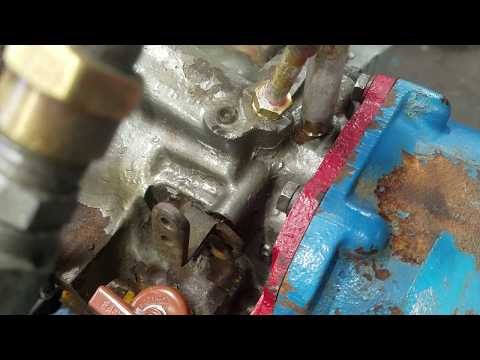
71C/72C and 1004/1005
The V-drive manual's own table for the 1004/1005 with the black spring is 115-135 psi in neutral, forward and reverse at 500 rpm and 125-160 at 2,000, also at 140°F.
Older units built with the white control-valve spring instead of the current black one run about 25 psi lower across the board: 90-120 in neutral at 500 rpm versus 115-135 for black-spring units at the same rpm. Chris has run into that white-painted spring on the bench and swapped it for a black one to bring pressure back up to spec.

| Position | 600 rpm | 2,000 rpm | 3,500 rpm |
|---|---|---|---|
| Neutral | 115-135 | - | - |
| Forward line | 115-140 | 125-160 | 135-180 |
| Reverse clutch/line | 120-140 | 125-160 | - |
Same story on a CR-2: on a 1014-005 we replaced the old white selector-valve spring and pressure went from about 100-110 psi to a rock-solid 150.
5000 and Liberty: why neutral is low
On a 5000 or Liberty, neutral pressure is low by design, about 10 to 50 psi at idle, because in neutral the pump flow bypasses the clutch pressure valve. In gear it jumps to 250 to 400 psi.
That's not a leak or a weak pump. The 5000/Liberty regulator sends pump flow straight to the cooler and lube circuit in neutral instead of holding it against the clutch pressure valve, so a reading in the teens or twenties at idle is normal, not a warning sign. Everything we've measured on our own stand over the years fits that pattern: readings in the 40s and 50s in neutral, and well over 300 once it's shifted into gear.

Paragon and ZF notes
A Paragon HJ7 on our stand should show over 100 psi in neutral, run at 300-350 rpm. On a Paragon HJ we've seen forward sit around 60 psi against 100 in neutral and reverse, which points to the sealing-ring area or the case rather than the clutch pack itself.
ZF/Hurth gearboxes aren't Velvet Drives and don't share this pressure table. On our own stand we run a ZF up around 450 rpm to spare the equipment, with the coupling left off; 250 psi is acceptable there, and we like to see 300-350. A ZF63A reading 350 psi in neutral, forward and reverse on our stand is a good unit. A low neutral reading that would be perfectly normal on a 5000 is a red flag on a ZF63, because the two designs regulate pressure differently.
What we look for on our stand
That's Hale's own round target for the cast-iron units and the V-drive box, comfortably inside the factory's 2,000 rpm band and above the idle-speed range in the table above. It's a bench number, not a substitute for the factory spec, and it's not the number to use on a 5000, a Liberty, or a ZF.
Reading the numbers
On a 71C, 72C or 1004/1005, neutral and forward line pressure should be about the same, since there's no separate forward tap. A drop from neutral to forward means the forward clutch is leaking somewhere. In Chris's experience, forward needs about 125 psi to hold while reverse will still apply on a good deal less, so a slow internal leak tends to show up first as no forward with reverse still working, not the other way around.
Test temperature matters too: the 71C/72C tables above are "typical at 140°F," while the older installation manual calls for running the unit up to 155-165°F before testing. And never run a 71C or 72C without a cooler or bypass tube hooked up. The regulator depends on cooler flow to hold line pressure in range, and without one, pressure climbs too high.
Related reading
Not sure what your gauge is telling you? Call (804) 333-3677, Monday through Friday 9 to 3 Eastern, or email sales@halemarine.com.
Common questions
Why is my 5000 or Liberty's neutral pressure so much lower than in gear?
That's normal. In neutral, pump flow bypasses the clutch pressure valve and goes straight to the cooler and lube circuit, so neutral reads 10-50 psi at idle while in-gear pressure is 250-400 psi.
What pressure should a 71C or 72C read?
At 140°F on a current-production (black-spring) unit: neutral 115-135 psi at 600 rpm, forward line 115-180 psi from 600 to 3,500 rpm, reverse 120-160 psi from 600 to 2,000 rpm. Older white-spring units run about 25 psi lower.
What gauge do I need?
0-200 or 0-300 psi for a 71C/72C or 1004/1005. A 5000 or Liberty needs 0-100 psi at the main service port and 0-500 psi at the clutch taps; a 0-300 gauge can peg on a 5000 in gear.
Sources
Public documents we used for this page. Links open other websites in a new tab.
- Borg-Warner Velvet Drive Service Manual, 71C/72C (Form 1289, 1988) (opens in a new tab) PDF, correctcraftfan.com