Velvet Drive shaft alignment: the factory method
The number
Velvet Drive's spec is 0.003 in (three thousandths) maximum between the coupling faces, about the thickness of a piece of paper. That's a maximum, not a target: aim for zero. You'll also see 0.005 in in Velvet Drive's 1982 installation manual. That's the limit for a different check, damper and adapter runout, not the coupling faces, so don't mix the two up.
Tools
You need the bolts out of the coupling, the pilot still engaged so the two halves stay centered on each other, and a feeler gauge that reads down to a couple thousandths. That's it. No special factory tool is required for the check itself, just patience and a way to hold the couplings together while you work around the flange. A helper makes it easier, since one of you has to keep the halves pulled together while the other feels the gap.
Step by step
Pull the coupling bolts and hold the two halves together by hand with the pilot engaged. Turn the prop shaft a full turn, stopping every 90 degrees to feel the gap with the gauge, then do the same turning the transmission coupling. The faces should be within 0.003 in of parallel all the way around. If the wide spot in the gap moves around the flange as you turn one side, the shaft or that coupling is bent, and adjusting the engine mounts won't fix that. Alignment itself gets adjusted at the mounts. This is a preliminary check, done before the transmission is bolted down for good.
Check it in the water, loaded
The preliminary check isn't the final word. Do a final check with the boat in the water, fuel and water tanks full, and the boat loaded close to how you actually run it. Hull flex and the extra weight change things enough that a coupling that lined up on the trailer or on stands can be off once the boat is loaded and floating.
When to recheck
Recheck alignment every season, after any grounding or a hard strike on the running gear, and after a haul-out. It's cheap insurance. "Pay the yard to check the alignment," Chris says. "It'll save you tens of thousands of dollars." He's seen this cause problems across the board, in direct drives, reduction models, and especially V-drives, where the shaft comes out from underneath the engine and the coupling is easy to overlook.

Signs it's out
A coupling nut that's backed off can point to an alignment problem. On one transmission that came back with the nut backed off, the damage inside was severe enough that the whole unit was a total loss, and misalignment was the likely cause, along with soft, spongy motor mounts that let the engine move more than it should. There should be no play in a mount at all. Misalignment is also on Velvet Drive's list of causes for a leaking output seal.

Don't paint or silicone the faces
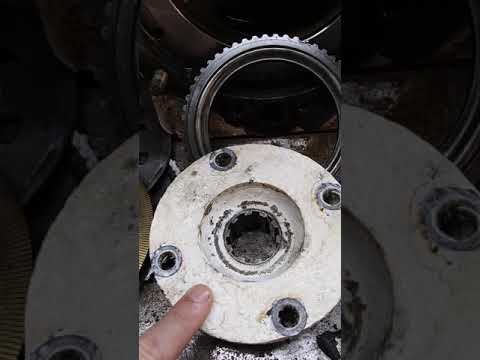
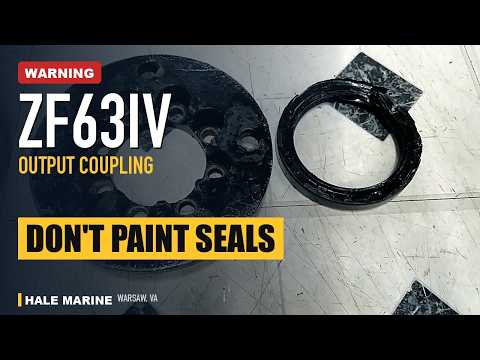
Never paint or silicone a coupling face. The tolerance is three thousandths of an inch, and a coat of paint is thick enough on its own to blow past that on both sides of the joint. We've seen it on cast-iron couplings and on a ZF63IV output flange alike: paint applied heavy enough that there's no way the assembly could have been within tolerance once it was bolted up.
Related reading
Common questions
What is the alignment tolerance for a Velvet Drive coupling?
0.003 in maximum between the coupling faces, about the thickness of a piece of paper. That's a maximum, and the target is zero.
Is 0.005 in ever an acceptable alignment number?
Not for the coupling faces. The 0.005 in figure in Velvet Drive's 1982 installation manual is for a different check, damper and adapter runout.
How often should I recheck alignment?
Every season, after any grounding or hard strike on the running gear, and after a haul-out.
Can I paint or silicone the coupling faces?
No. A coat of paint or silicone is thick enough to push the fit past the 0.003 in tolerance on its own.
Sources
Public documents we used for this page. Links open other websites in a new tab.
- Velvet Drive Liberty Series Owner's Manual (2005) (opens in a new tab) PDF, harbormarine.net
- Velvet Drive 71C/72C Owner's Manual (opens in a new tab) PDF, tadiesels.com