Paragon Transmissions
 By Chris, Hale Marine · 40+ years rebuilding Velvet Drive and ZF transmissions
We work on Paragon transmissions. On the channel you'll find the HJ7 (including a 2.5:1), the older HJ, and the P34 and PV water-cooled V-drives. Usable parts can be hard to come by. On one HJ7 job, Chris had taken three of them apart and was getting very little he could use from the transmission portion. On a P34 that had him stumped, he sent it to his cousin Barry, who worked on these from the 60s into the early 2000s.
Where the reversible pump came from
Paragon is the company that made a single pump work behind either engine rotation in the first place. Robert Seavey's patent, filed in 1950, granted in 1954 and assigned to Paragon Gear Works, let one pump serve either rotation just by rotating internal parts about 180 degrees, instead of building two separate pumps like the earlier Packard units did. Paragon had that pump in production for years before Borg-Warner took an interest in marine hydraulic transmissions in 1956. A federal court later found that Borg-Warner got hold of a Paragon unit, took it apart, measured it, and copied the pump design after its own attempt didn't work out. Paragon won that case in 1964, and the First Circuit upheld it on appeal in 1965.
Pump problems and rotation
The PV water-cooled V-drive design goes back to the 1940s. It uses a band assembly and straight-cut gears. On an HJ7 job, both pumps had slime inside, the pump bodies were scored up and the gears were chewed up.
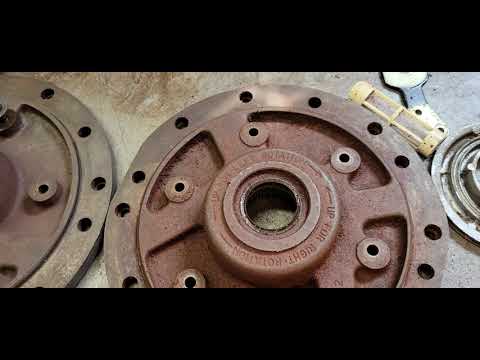
Changing rotation on a Paragon is a different job from the cast-iron Velvet Drives. You take off the plate held on by two recessed bolts, one on top and one on the bottom, and you don't touch the bolts that hold the pump on. Hold the input shaft down while you lift the plate, or it can pull the input shaft up and break the sealing rings. See changing pump rotation for the details.
Pressure
On an HJ7, anything over 100 psi in neutral is a good reading, tested at 300 to 350 rpm on our stand. On one HJ, forward pressure ran noticeably lower than neutral or reverse, about 60 psi against roughly 100. Chris's guess was the sealing-ring area or the case itself, though he wasn't certain which.
Some noise on the reverse shift is normal on a Paragon, and pressure will dip during that shift before settling back to about 100 to 120 psi. If reverse is weak on a P-series V-drive, check the reverse band adjustment first, then the linkage arms on the reverse piston, before you assume something's broken inside.
Fluid
We recommend a Dexron III-type ATF in Paragons, the same as we recommend for the old cast-iron Velvet Drives. No synthetics, additives or stop-leak. They swell the O-rings until they break apart. See our fluid guide for more on which fluid to buy.
Related problem articles
Common questions
Did Paragon really invent the reversible marine transmission pump?
Yes. Robert Seavey's patent, assigned to Paragon Gear Works and granted in 1954, let one pump serve either engine rotation by turning internal parts about 180 degrees. A federal court later found Borg-Warner copied that design after studying a Paragon unit, and Paragon won the case in 1964, upheld on appeal in 1965.
What pressure should a Paragon HJ7 show in neutral?
Anything over 100 psi in neutral is a good reading on our stand, tested at 300 to 350 rpm.
Sources
Public documents we used for this page. Links open other websites in a new tab.