Velvet Drive 71C Series
The 71C is the cast-iron 71 series Velvet Drive, in part numbers starting 1017. It comes as a 1:1 direct drive (like the 1017-004) and in reduction ratios, like the 1.5:1 (1017-005 and 006), the 1.91:1 (1017-008), the 2.10:1, the 2.57:1 and the 2.91:1.
What to know about the 71C
Chris thinks the 1.91:1 is the best reduction model Velvet Drive produced. Its planetary is fixed in place with a bearing and snap-ringed in two places, so it doesn't float. The 2.10:1 is another story. Its planetary floats on washers, and Chris calls it the worst transmission Velvet Drive did in the 71 and 72 series in-line configuration, because it generates a lot of heat. You can spot one because the return cooling line sits on top of the reduction planetary. On most transmissions the return port is elsewhere, but on the 2.10:1 they put a plug there and moved the return on top of the planetary.
Some late-1970s and early-1980s units used a collapsible spacer in the reduction housing, set at the factory with pre-torqued assembly tools. Don't reuse it. If you lay into it again with an impact gun, it'll crush and you'll have a sloppy back end. Put in a solid spacer, which is the current production part.
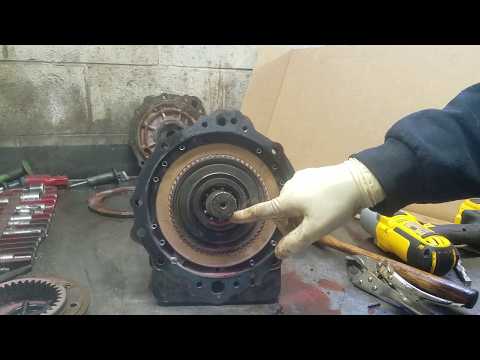
Inside the clutch pack, the 71 series (1017) uses two snap rings, versus three on the 72 series (1018). There's a groove on top of the clutch pack pressure plate that looks like it's for a snap ring. The groove is for nothing.
What we look for on a teardown
A loose output coupling nut lets the coupling move in and out and beat against the bearing, cutting a groove in it. It's best to buy a new nut, because the nylon locking ring isn't really meant to be reused.
Water shows up as a "strawberry milkshake" color inside. An overheated unit will have a phenolic washer that's gone brittle enough to snap. And clutch plate teeth should be perfectly square. When they start to chatter, that's significant wear.