How to Identify Your Velvet Drive or ZF Transmission and Its Ratio
 By Chris, Hale Marine · 40+ years rebuilding Velvet Drive and ZF transmissions

Part number prefixes tell you the series
Velvet Drive part numbers follow a pattern. The prefix tells you which family you're holding before you even get to the ratio:
| Part number prefix | Series |
|---|---|
| 1017 | 71C (cast iron) |
| 1018 | 72C (cast iron) |
| 1004 / 1005 | Cast-iron V-drive |
| 1013 / 1014 | CR-2 |
| 2001 / 2002 | 5000A / 5000V |
| 3001 / 3002 | Liberty series (5000 family) |
The prefix alone doesn't tell you direct drive or reduction. A 1017-004 is a 1:1 direct drive, while a 1017-005 or 006 is a 1.5:1 reduction. And you can't turn a 1:1 into a reduction by bolting a reduction unit on: the input shaft and clutch packs match, but the reverse planetary assemblies don't, and the cases are different too.
Where the ID tag is, and what's on it
On a cast-iron unit the tag sits on top of the left-hand transmission mount; on a Liberty it's on the mounting boss. The model is printed below the word "Velvet Drive," the ratio sits to the left of that, and the serial number is to the right. Watch for one trap when you're reading a number off the case itself rather than the tag: the number cast into the housing is often a casting number, not the model number, so don't call the transmission by whatever's stamped into the iron. For the full walkthrough, see how to read a Velvet Drive ID tag.
No tag on a 71C or 72C? Measure it
Without a tag, measure from the bellhousing face to the output flange. A 71C direct drive runs about 10.5 in and a 72C about 11.44 in, so the 72C is roughly an inch longer; the reduction versions run about 16.9 in and 17.8 in. There's also a ratio tell that doesn't need a tape measure at all: every 72C runs its reverse about 10% deeper than forward (a 1:1 reverses at 1.10:1, a 1.52 at 1.68:1, a 1.91 at 2.10:1, and so on), while on a 71C forward and reverse are the same ratio. If a transmission reverses deeper than it goes forward, it's a 72C.
The Liberty series is the 5000 family under another name. Chris has shown a 3001-004 alongside its 2001-004 number, and says a Liberty 3002 has basically the same guts as a 2002 5000 V-drive. The main difference is the case: they beefed up the casting and changed the pump housing style, but it still uses the same pump.

Identifying a V-drive with no ID tag
If the tag on a 1004/1005 V-drive is missing, Chris knows of two ways to get the ratio. First, count the teeth on both sets of gears and do the math. Second, take the V-drive section off the transmission section, rotate the shaft, and count how many times the input shaft goes around versus the output shaft.
Telling 71C/72C ratios apart
The 1.91:1 reduction came out back in the late 1950s and was used up until, as Chris puts it, the late 70s or early 80s. He thinks it's the best reduction model Velvet Drive produced. Its planetary is fixed in place, like on the 2.5:1 and 2.9:1. There's a bearing that holds it and it's snap-ringed in two places, so it doesn't float. On the 1.52:1 and 2.10:1, the planetary floats with washers, so now you've got some slop and extra heat.
You can spot a 71 or 72 series 2.10:1 because the return cooling line goes on top of the reduction planetary, trying to cool it. Chris calls the 2.10:1 the worst transmission Velvet Drive did in the 71 and 72 series in-line configuration. Nothing binds the reverse planetary to the case, so it generates a lot of heat. If it were his boat, he'd put a 1.9 to 1 in.
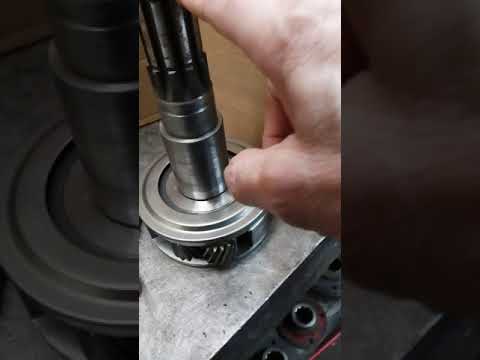
Telling reduction planetaries apart at a glance
Only three kinds of units use the floating reduction planetary with the little tab washer: the 1.5:1 (1017-005/006 and 1018-004/005), the 2.10:1, and all the V-drive models. No direct drives, 1.9:1, 2.57:1 or 2.9:1 units use that thrust washer. If you see the tab washer, you're looking at one of the floating-planetary models.
The 1.88:1 and 1.91:1 reductions are also the only ones that turn the output opposite the input; every other 71C/72C reduction (1.523:1, 2.10:1, 2.57:1, 2.91:1) turns the same way the input does.
ZF63 family: counting teeth for the ratio
On a ZF63IV with a mystery ratio, count the teeth on the two faces of the output shaft, then count the teeth on the input shaft, and that gives you the ratio. The back gear on the clutch pack, close to the pump, is the same on all of them except the 2.5:1. The front one, close to the splined end, is different for each ratio. On the ZF 63s, 800s and 80s, the input shaft is a different size for every ratio, but the sealing-ring side and pump side are always the same, so you don't have to worry about mixing up the gears on either side.

5000A vs 5000V
On the 5000 V-drive, the lay shaft and input shaft use the same size gear. On a 5000A you'll have a taller one and a shorter one: the shorter one goes on the input shaft and the taller one goes on the lay shaft. That's because the V-drive case is deeper, so the shafts line up to the gears differently.
The 5000/Liberty family also has nominal-versus-actual ratios worth knowing, since they explain why you'll see two numbers for what's really the same unit:
| Nominal | Actual |
|---|---|
| 1.00:1 | 1.054:1 |
| 1.25:1 | 1.303:1 |
| 1.50:1 | 1.586:1 |
| 2.00:1 | 2.040:1 |
| 2.50:1 | 2.454:1 |
| 2.80:1 | 2.800:1 |
On a 5000V, you can also work out the ratio by counting teeth: the intermediate shaft runs 28, 31, 36 or 39 teeth for 1.25, 1.50, 2.0 and 2.5, and the input- and lay-shaft clutch gears run 35, 33, 29 or 25 teeth to match. The output gear is the same part across every ratio.
Cast-iron V-drive (1004/1005): gear drive vs chain drive
On the 1004/1005, forward is always toward the engine at the lever, but the output can turn either the same way as the engine or the opposite way, and it's fixed at the factory, not something you set later. A gear-drive unit turns the output the same way as the engine; a chain-drive unit turns it opposite, which is how two same-rotation engines on a twin can still get opposite-turning props. Specify which one you need when you order. Velvet Drive's ratio pairs for this family run from about 0.96:1 up to 3.14:1; see our part number cross-reference for the specific assembly numbers.
CR-2 (1013/1014) note
These transmissions are obsolete. Some of the components, like the clutches, pump, input shaft seal, neutral safety switch, shift lever housing, selector valve and pressure regulator, are different and can't be swapped one to the other. Chris's advice is that it's best not to deal with these if you can, but there really isn't a good replacement. If you have a 1013 or 1014, call before you order parts.
If you're not sure what you're looking at, call us at (804) 333-3677, Monday through Friday 9 to 3 Eastern, or email sales@halemarine.com.
Related guides
- Velvet Drive transmission fluid: what to use and why
- How we rebuild a marine transmission
- Buying a boat with a V-drive? Read this first
- How to read a Velvet Drive ID tag
Have an old Borg Warner number instead of a Velvet Drive one? See our Borg Warner to Velvet Drive part number cross-reference.
Common questions
How do I find the ratio on a V-drive with no ID tag?
Count the teeth on both sets of gears and do the math, or take the V-drive section off and count how many times the input shaft goes around versus the output shaft.
What's the difference between a 5000A and a 5000V?
On the V-drive the lay shaft and input shaft use the same size gear. On the 5000A there's a taller and a shorter one: the shorter goes on the input shaft and the taller on the lay shaft, because the V-drive case is deeper.
Are the Liberty series 3001/3002 transmissions different from the 2001/2002 5000 series?
They're basically the same guts. The main difference is the case: a beefed-up casting and a different pump housing style, using the same pump.
Sources
Public documents we used for this page. Links open other websites in a new tab.
- Velvet Drive 71C/72C Owner's Manual (opens in a new tab) PDF, tadiesels.com
- Velvet Drive Liberty Series Workshop Manual (opens in a new tab) PDF, simplicity-marine.com