How We Rebuild a Marine Transmission
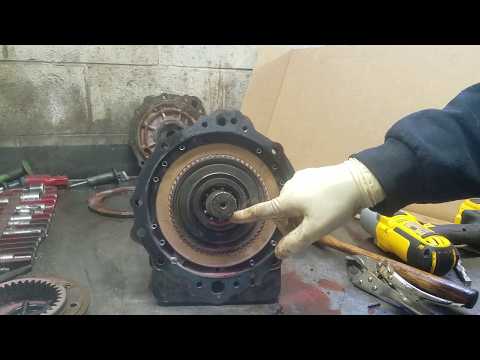
A rebuild here means a full teardown and inspection, a brand new pump, and a run on the test stand, on video, before it ships. Here's what that actually looks like.
Teardown
First step is marking the pump before it comes off, so it goes back on in the same left- or right-hand orientation it came in with. From there the pump housing comes off, then the gear, and this is usually the first place you'll see trouble: if the parts underneath show a "strawberry milkshake" color, the transmission had water in it at one time or another.
From there we pull the keyway, remove the reverse adapter plate, and get into the clutch packs. We're checking the clutch plate teeth for wear (they should be square-edged, not chattered or rounded), checking the phenolic washer for brittleness (a sign of overheating), and checking the input shaft splines for sharp, crisp edges. We check the planetary for side-to-side movement and worn bushings, and run a finger around the inside of the case feeling for grooves. Grooves that don't go all the way around mean the transmission was misaligned at one point, and the sealing rings cut into the case.

What we found on this one
This 1017-004 is a good example of what a teardown turns up:
- The strawberry milkshake color that means water got in at some point
- Dirt like clay packed in the sump. Chris figures the owner ran aground in a lake somewhere
- Grooves in the case from misalignment
- Forward clutches that were warped, not flat. That's overheated clutches, and it's why the unit was locked up in forward
New pump, every time
We always put a new pump on every transmission. There are cheaper guys out there, but we make sure we build them right. We can afford to do it because we buy our parts directly from Velvet Drive. Most independent shops can't, because it's expensive. All the 5000s, particularly the V-drives, must have a new pump, and depending on how the unit came in, some get the entire control block assembly replaced too.
Paint and prime
Once the unit is rebuilt, we air-blast it to knock the old paint chips off, then usually give it a good primer or a coat of paint. We don't send out rust buckets. Chris's advice if you're painting a transmission yourself: don't paint it black. The engine people like black, but you can't see leaks. Paint it blue, yellow, anything but black.
One surface we never touch with paint: the output coupling face. You're only allowed 3 to 5 thousandths between the transmission coupling and the propeller shaft coupling. Put paint on that surface and it's going to be misaligned, and you'll burn up the transmission or the stuffing box. See don't paint the coupling face.
Test stand
Chris videotapes every transmission that comes and goes, and nothing leaves until he's satisfied with it. We run it for an hour and a half on the stand. The stand runs at 535 rpm and can also run at 864. We check neutral, forward and reverse pressure, look for leaks and listen for abnormal noise or vibration. High-ratio gears put a lot of load on a unit, and a ZF63IV 2.5:1 heading to the Bahamas got its hour and a half to make sure everything worked fine.
That time on the stand is why we run them. On one unit, after about an hour we noticed forward pressure dropping, and it turned out fluid was cross-feeding across the selector valve. On a V-drive, the dipstick tube started to leak after about half an hour.

Shipping: send only the transmission
If you're sending us a unit for repair, send the transmission itself. Don't send the cooler, cooling lines, bell housing, linkages or mounts. It takes us extra time to get all that off, and that's an added charge for you. We test and video units before they go back out so you can see your transmission was operating properly when it left our shop.
Bolt torque and setup
We publish 1017/1018 bolt torque specs separately, see our torque spec page for that video. For pump rotation setup, see our pump rotation guide.
Questions about a rebuild, a core, or what your unit needs? Call (804) 333-3677, Monday through Friday 9 to 3 Eastern, or email sales@halemarine.com.
Related guides
Common questions
Does every rebuild get a new pump?
Yes. We always put a new pump on every transmission. On some 5000-series units the whole control block assembly gets replaced too.
How long does a rebuilt transmission run on the test stand before shipping?
We run it for an hour and a half on the stand, and every transmission is videotaped.
What should I send with a transmission for repair?
Only the transmission itself. Don't send the cooler, cooling lines, bell housing, linkages or mounts. Removing them adds time and an extra charge.