Collapsible vs. solid spacers
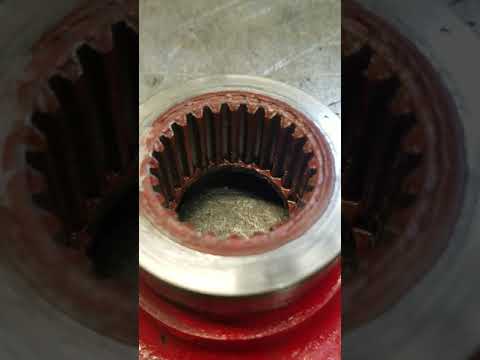
What Chris has found on the bench
- A very early output shaft on a 71C 2.10 with a collapsible spacer that had been crushed further than the factory set it, leaving extra clearance so the coupling wore on the bearing on the back of the transmission.
- A collapsible spacer in an early-80s 1.5:1 reduction unit where it looked like the customer had tried to reuse it, with some of the flange ground down.
What causes it
Back in the late 70s and early 80s, Borg-Warner decided it was cheaper to use a collapsible spacer. They were trying to save a step. They pre-torqued their assembly tools, most likely an impact gun, and ran the coupling down so the spacer collapsed to the right facing and torque load at the factory. That works fine the first time.
The problem shows up during a rebuild. Torquing the coupling back down on that same spacer crushes it further than it was before, and that opens up extra clearance. That clearance lets the coupling wear on the bearing behind it. If you lay into it with an impact gun like most people do, it'll crush and you'll end up with a sloppy back end.

Fix and prevention
If you find a collapsible spacer in a unit you're rebuilding, don't reuse it. Put a solid spacer in. That's the current production part, and it's what should have gone in on the units Chris has shown.
When to call
If your transmission is from that late-70s to early-80s era and you're having it rebuilt, ask whether it has a collapsible spacer. Call (804) 333-3677, Monday through Friday 9 to 3 Eastern, or email sales@halemarine.com.
Related reading: output nut backing off and coupling damage and how we rebuild a transmission.